
Who is an Automation Entrepreneur?
Definition
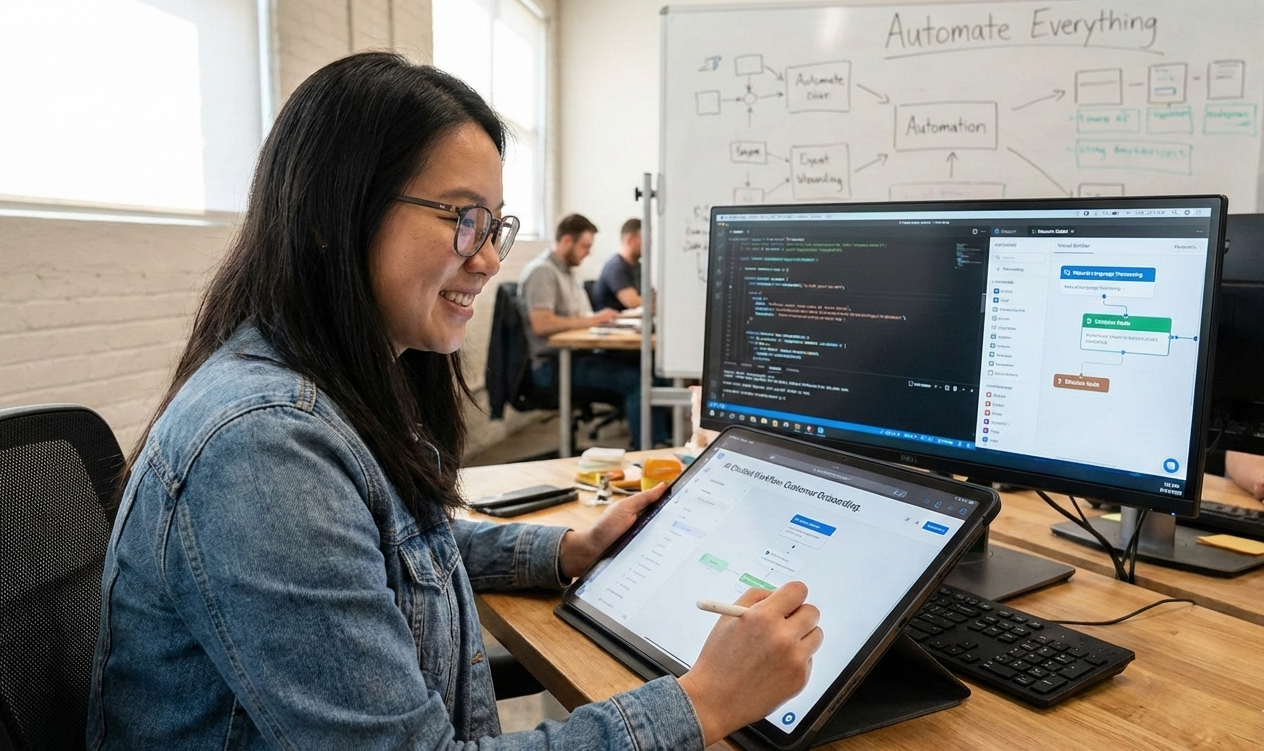
As an Automation Entrepreneur, you identify repetitive manual tasks, whether in your own business or for others, and then use “no-code” or “low-code” software to manage those tasks.
With this model, you leverage technology to create, implement, and sell automated systems or tools that streamline tasks, boost productivity, and solve problems for businesses or individuals.
Ultimately, what you want to achieve as an Automation Entrepreneur is the building of a system that can function with minimal human intervention. In other words, instead of people doing the work manually, you build a tool that can do the work automatically.
Examples
• Building Chatbots: Designing simple AI-powered bots using platforms such as ManyChat or Dialogflow for customer support on websites or social media, and then offering them as a service or product. With AI chatbots, customer service as an example, can be provided 24/7.
• Content automation tools: The Automation Entrepreneur develops scripts or bots that can automate social media postings, email campaigns, and so on.
• Freelance automation services: This involves using tools such as Zapier or Make.com to connect apps (e.g., automating lead capture from a website form to a CRM like HubSpot) and charging clients per project. Briefly, lead capture involves collecting details such as email, name, or phone number, from potential customers (leads) for future marketing and sales engagement.
• Selling automation templates: The Automation Entrepreneur creates pre-built workflows (e.g., an email automation sequence for e-commerce stores) and sells them on marketplaces such as Gumroad or Etsy.
Skills
• No-code proficiency: As a beginner it is best to get a basic understanding of no-code tools such as Airtable, Bubble, Zapier, Make.com, or GoHighLevel. These tools allow you to connect different apps and build automations without programming.
• AI prompting: Learn or improve your knowledge on how to effectively use Large Language Models (LLMs), such as Gemini or ChatGPT, to generate high-quality automation outputs.
• Problem-solving: Utilizing your problem-solving skills in order to identify repetitive tasks, whether in a business, or through daily experiences.
Advantages for Beginners
• Low entry barriers: Can be started with free or affordable tools. No need for inventory or physical space, allowing you to work from anywhere with just a computer and Internet. Most automation tools also have free tiers or low monthly costs, so you don’t really need a large initial investment.
• High demand: Businesses are increasingly seeking efficiency in this competitive digital economy, creating ongoing opportunities for beginners.
• Scalable growth: Automations can run passively, thereby allowing you to earn income without constant effort.
• No-code: The automation entrepreneur model is particularly beginner-friendly because it can be done with no-code or low-code tools, allowing newcomers to start without advanced technical expertise.
Monetization
• Setup and maintenance fees: As an Automation Entrepreneur you could charge a one-time fee, maybe $500 to over $5,000, to build a custom automated system for a business. A monthly maintenance (retainer) fee could also be charged.
• Freelance gigs/consulting: Using platforms such as Upwork or Fiverr, you could offer an automation setup service, charging anywhere from $50 to $500 per project.
• Digital products: Another aspect of the business could be the sale of pre-made automation templates, guides, or “snapshots” (pre-built workflows) on marketplaces such as Etsy or Teachable, thereby earning passive income.
• Affiliate Income: Recurring commissions could be earned by recommending the software tools used by you and your clients.




Leave a Reply