
From Idea to Online Business: The Basic Systems You Need to Get Started
Finding customers is hard enough, but surviving the tech stack can make starting an online business feel rather difficult at times.
You begin with a single website. Before you know it, you have to deal with email sequences, landing pages, lead magnets, payment processing, automation rules, and a growing list of apps you never knew existed.
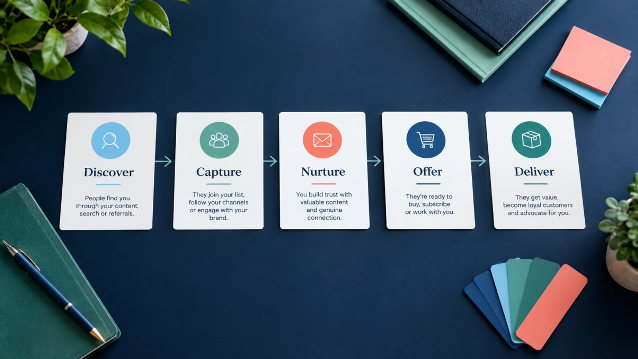
Eventually, you may find yourself comparing dozens of platforms and wondering which tools you actually need. However, an online business doesn’t really need to start with a complicated technology stack. It starts with a simple journey:
Someone discovers you, becomes interested, stays connected, sees an offer, and becomes a customer.
An Online Business Is More Than a Website
A website can be an important part of an online business, but by itself, it isn’t a business system. You also need to find ways to:
• Attract people
• Capture interest
• Communicate with potential customers
• Present an offer
• Collect payments
• Deliver what you’ve promised
Needless to say, you don’t need a separate platform for every one of these jobs. The important thing is to understand how the pieces actually fit together.
The Five Parts of a Simple Online Business
- Attract
First, people need a way to discover you, and this can be done through:
• Blog articles
• YouTube
• Pinterest
• Social media
• Search engines
• Referrals
• Communities
Here, the objective isn’t simply to announce your website. What you want to do is to attract people who are interested in the problem you solve.
2. Capture
Certainly, not everyone who discovers your business will immediately become a customer. That’s why capturing interest is such a valuable aspect of digital marketing.
To capture interest, a simple lead magnet (free offer) could be in the form of:
• A checklist
• A guide
• A worksheet
• A template
• A mini-course
• A resource list
In exchange for the lead magnet, the visitor can voluntarily join your email list.
3. Nurture
Now, you have an opportunity to build a relationship. Your emails should provide:
• Useful information
• Answers to common questions
• Practical tips
• Relevant resources
• Examples
• Occasional offers
Here, the objective isn’t to send out endless promotional emails. It’s to become a useful source of information so that people will understand why your eventual offer might be relevant to them.
4. Offer
Eventually, your business needs something that people can purchase, such as:
• A digital product
• A course
• A membership
• A service
• A consultation
• A physical product
Now, you don’t necessarily need ten or more offers. One useful offer could be enough to begin learning what your audience actually wants.
5. Deliver
Finally, your customers need to receive what they purchased, and this could involve:
• Sending a digital download
• Providing access to a course
• Scheduling a service
• Granting membership access
• Sending a confirmation email
It is easy to overlook this final stage when you’re so focused on marketing. However, delivery is one of the most critical aspects of the customer experience.
The Problem With Too Many Tools
As you may have noticed, none of these functions is particularly unusual. The challenge comes when each function lives somewhere separately.
For example:
• Website – Platform A
• Landing page – Platform B
• Email – Platform C
• Checkout – Platform D
• Digital product – Platform E
• Automation – Platform F
Individually, these tools might work perfectly well. But, you need to understand how they connect. You may need integrations, additional subscriptions, separate logins, and different interfaces. For some businesses, that complexity may be manageable. For others, it may simply create more work than necessary.
When Does an All-in-One Platform Make Sense?
An all-in-one platform can be useful when you want several business functions to work together, without assembling everything yourself. The potential advantages include:
• Fewer platforms to manage
• Fewer integrations
• One central account
• Simpler workflows
• Less technical setup
If you’re building an email list, selling digital products, and creating automated customer journeys, then having multiple functions available in one system may be the right move to make.
A Look at Systeme.io
Systeme.io is one platform designed around this all-in-one approach. Its features include tools for areas such as websites and landing pages, email marketing, sales funnels, automation, online courses, memberships, and digital-product sales.
All of that makes Systeme.io particularly relevant to creators and solopreneurs who want to bring several parts of an online business together.
What Could a Simple Setup Look Like?
If you’re creating a small digital-product business, for example, you could start with:
- Creating useful content: Publishing articles, videos, or other content that solves problems for your target audience.
- Offering a useful free resource: Creating a simple checklist or guide related to one of those problems.
- Capturing email subscribers: Giving visitors an easy way to request the resource and join your email list.
- Creating a short welcome sequence: Introducing yourself, providing useful information, and helping subscribers understand the problem you’re solving.
- Introducing your paid offer: Once there’s a logical connection with the free resource, you can explain how the paid product will help them go further.
- Automating: Once you’ve tested the process manually, automate repetitive parts of the journey.
When Systeme.io May Be Worth Exploring
If you’re looking for a way to bring several online-business functions into one platform, Systeme.io is one option you can investigate.
It may be particularly relevant if your plans include:
• Building an email list
• Creating landing pages
• Selling digital products
• Creating sales funnels
• Setting up automated email sequences
• Delivering online courses or memberships
Explore the Systeme.io platform and evaluate it against your needs.
As you build your online business, systems will help to make things happen more efficiently and consistently. Start small; create a simple path from discovery to purchase. After that, you can improve and automate parts of your online-business functions into one platform.
Also read: What to Outsource When You’re Building an Online Business on Your Own.